
A major heat wave is forecast for the first week of July in New Jersey.
“Dangerous triple digit heat is forecast for later this week and into the holiday weekend,” the National Weather Service said in a statement. “All time record high temperatures could be challenged and multiple 100 degree days could occur.”
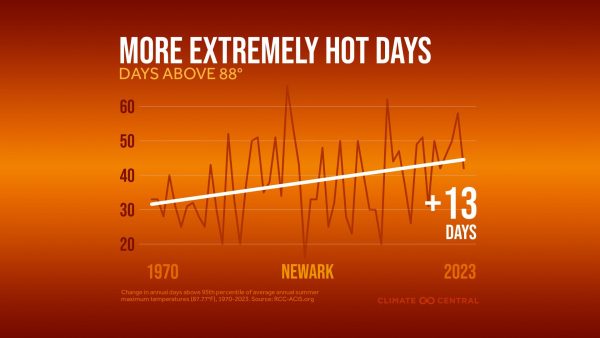
New Jersey is getting hotter, increasing the risk of youth athletes.
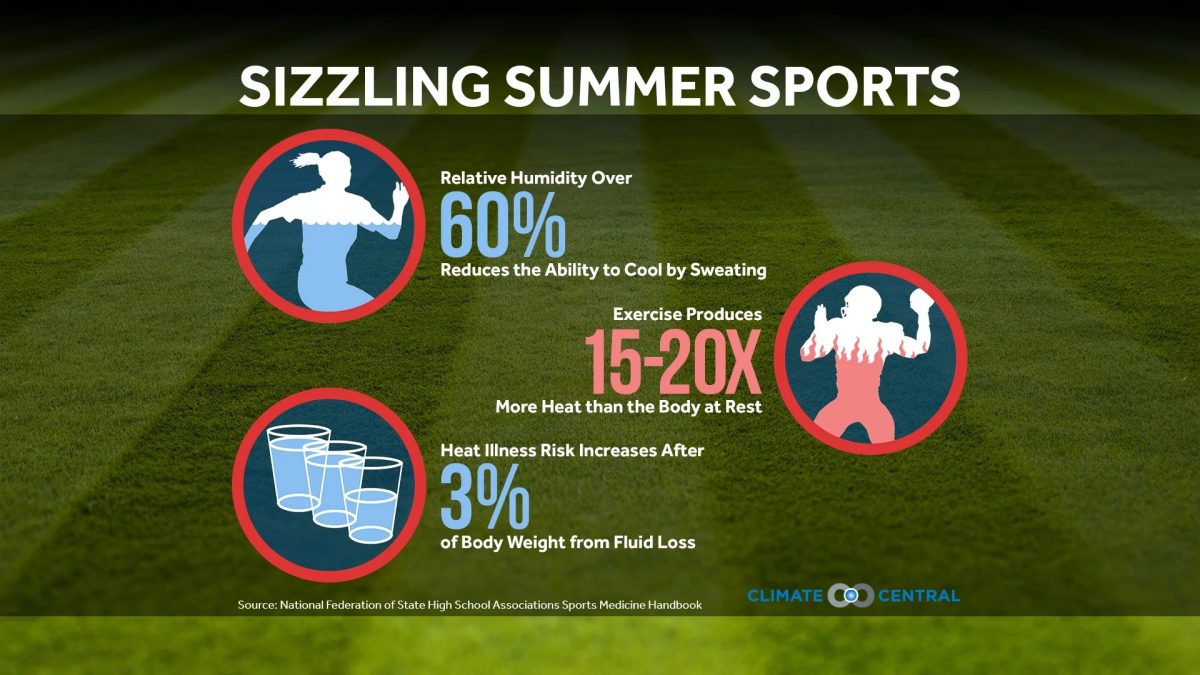
Playing or practicing sports outside with rising temperatures increases the risks of heat-induced illness — a danger made even greater by heat trapped in equipment like helmets and pads.
Heat stroke — a life threatening emergency caused when the body overheats — is the most serious heat-related illness.
For children and young adults, that risk is heightened.
“Heatstroke is a serious medical condition,” said Connie Kostacos, a pediatrician at Columbia told the Columbia University Irvington Medical Center. “Children feel heat and humidity faster and more severely than adults and have a harder time cooling down.”
Symptoms vary by person, but can include nausea, vomiting, dizziness, and confusion. If left untreated, it can cause permanent disability or death.
In 2018, 19-year-old Braeden Bradforth, a Neptune High School football standout, died from heat stroke after his first day of football practice at Garden State Community College in Kansas.
After the event, a report found that the coaching staff was not sufficiently prepared to ensure safety at practice or to deal with heat illness.
Protecting kids from heat
The New Jersey State Interscholastic Athletic Association (NJSIAA), the governing body of hundreds of high schools in New Jersey, is committed to protecting high school athletes from dangerous heat.
Peter Koeniges is an athletic trainer at Northern Highlands Regional in Allendale and a member of the NJSIAA Sports Medicine Advisory Committee — which provides the NJSIAA executive committee with resources, guidance, recommendations, and best practices that focus on the health and safety of student-athletes.
The group meets four times a year and consists of athletic trainers from high schools across New Jersey.
NJSIAA has their own Heat Participation Policy, designed to prevent heat-related illnesses in student-athletes by regulating activity in hot conditions. The policy uses the Wet Bulb Globe Temperature (WBGT) to measure outside temperatures, not the Heat Index.
WBGT accounts for temperature, humidity, sun exposure, and wind when determining the temperature, making it more accurate for activities in the direct sun. The Heat Index was designed to measure temperatures in the ambient shade, making it an inaccurate measurement for sports.
“It really depends on the Wet Bulb [Globe Temperature], as far as you know, what modifications that we’ll have to take advantage of,” said Koeniges. “So that’s my whole thing – to try to prevent anybody from having heat symptoms.”
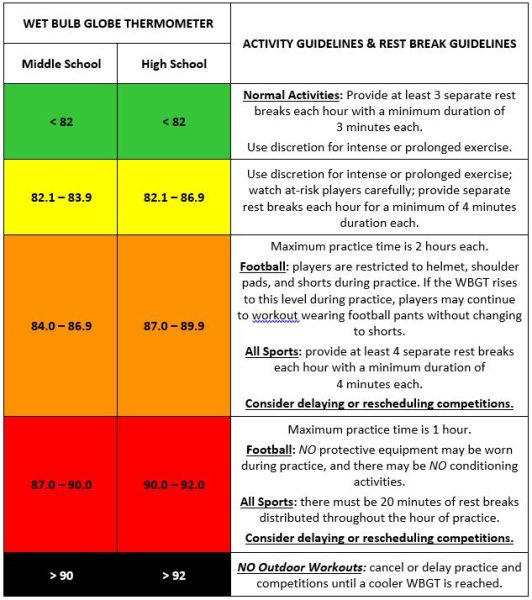
NJSIAA requires that WBGT readings be taken 30 minutes before activity and every hour during it. It applies to all sports, practices, and games with no seasonal limits.
Athletes must have unlimited access to liquids and breaks in shaded “cooling zones.”
When temperatures rise above 90 degrees, outdoor workouts aren’t allowed.
Helmets must be removed during breaks. At higher heat levels, cooling towels are required.
Overcoming local challenges
Koenige’s school in Allendale is well-funded and the district is regularly ranked among the top public schools in New Jersey.
But not every district has the same resources when it comes to heat protocols.
“I’ve talked to other athletic trainers around the state, and they’ve talked to me about how they have, like, giant ice baths and things like that. But you know, for some schools, funding really is an issue,” said Koeniges.
Public schools in poorer areas of the state, such as Camden or Newark, don’t have as many funds. This makes supplying proper materials to treat heat stroke in students much more difficult.
One issue that arises is getting a WBGT thermometer. The top rated thermometer for school use, the Kestrel 5400 Heat Stress Tracker, retails for over $500.
To combat the cost, the National Federation of State High School Associations (NFHS) began offering a grant program in 2022 that supplied 5,000 WBGT thermometers to high schools across the country. The $1.5 million program aims to provide schools with the resources they need to keep their students protected from heat-related illnesses.
Each thermometer is calibrated by geographic zone and comes with a tripod and bluetooth capability for school administrators to access information via phone. The NFHS also provides a tutorial video through the NFHS Learning Center on how to operate the device.
Also not every protocol is expensive.
Koeniges mentioned the TACO method (Tarp-Assisted Cooling with Oscillation) to treat severe heat stroke. The method involves laying a person on a tarp, covering them with ice or water, and moving them back and forth to maximize heat dissipation.
“It’s all about communication between the athletic trainer and the coaches to be able to make those appropriate modifications,” said Koeniges. “That’s what’s going to help.”