
Earlier this month residents of some South Jersey counties were able to see the sky glowing with streaks of green and pink light, a phenomenon more typically seen in places like Iceland or Alaska.
The display was fueled by a rare G4 geomagnetic storm, among the strongest in years, triggered when a massive burst of charged particles from the sun slammed into Earth’s magnetic field. The National Oceanic and Atmospheric Administration (NOAA) Space Weather Prediction Center had predicted that the storm could push auroras farther south than normal. The occurrence also happened last year in October 2024.
Dr. David Klassen, a physics and astronomy professor at Rowan University, said the sightings serve as a reminder of how closely tied Earth is to the forces of space.
“When South Jersey sees the aurora, it means the sun is exceptionally active,” said Dr. Klassen. “Most of the time it’s nothing to worry about, just a spectacular light show, but it’s also a glimpse of how our planet and our star are constantly interacting.”
Scientists who study the phenomenon say the auroras were the result of one of the G4 geomagnetic storms over the United States.
These storms typically trigger massive bursts of charred particles from the sun that hit the Earth’s magnetic field. The collisions are often energetic gases in the atmosphere that produce vivid streaks of light.
Geomagnetic storms release bursts of energy through solar flares and coronal mass ejections.
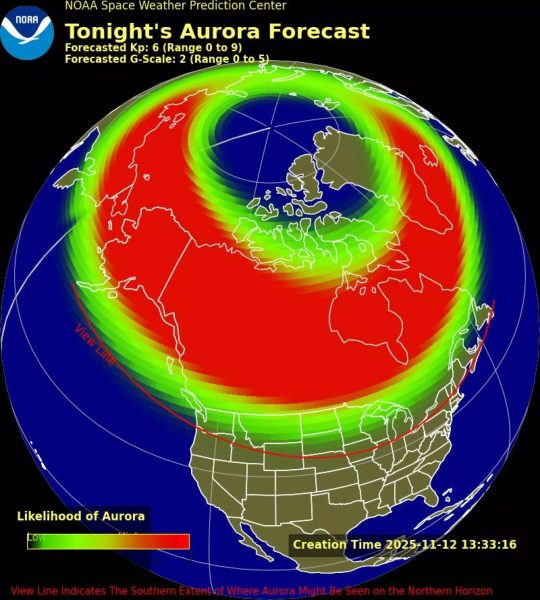
When those particles collide with the planet’s magnetic field they can also interfere with technology on the ground.
Stronger storms like the ones in November have the potential to disrupt GPS signals, weaken radio communication, and add stress to Earth’s power grids. Though no major issues were reported in New Jersey.
Experts say that geomagnetic storms might become a more common phenomenon as the sun nears the peak of its 11-year activity cycle, which is a period marked by more intense magnetic activity and frequent solar eruptions.
Seeing auroras in South Jersey is still relatively rare. To be visible, they need to line up almost perfectly and require a powerful solar burst, the right angle towards Earth, and clear night skies.
The event even surprised Camryn Marty, an assistant at the Ric and Jean Edelman Planetarium at Rowan University, who helps program events that let students and visitors experience a virtual aurora borealis through the planetarium’s shows.
“You don’t expect to walk outside in South Jersey and see the sky glowing pink and green,” said Marty. “That’s part of what makes them so special.”