This story was originally published by NJ Spotlight News through the NJ News Commons.
Two months ago, Gov. Mikie Sherrill announced a plan to restrict — though not ban — artificial intelligence data centers statewide.
Many local leaders say that’s not enough. Since February, at least two dozen municipalities have prohibited the facilities within their borders.
Since 1917, New Jersey’s entrenched system of home rule, or local government authority, has blocked all sorts of development, from garbage dumps and hazardous waste disposal sites to marijuana dispensaries and mandated affordable housing. Once it kept what is now the Great Swamp, in Morris and Somerset counties, from becoming a 45-square-mile airport. Now town officials are training their zoning powers on data centers in a state with roughly two dozen of them, and several under construction.
While the buildings enable high-value global computing to advance health care, test disaster responses and automate supply chains, they bring tremendous local downsides. The servers can take up acres that residents instead may want for more houses. The buildings draw heavily on electricity and water supplies. And in some places, the irritating hum of constant operations can be heard a mile away.
Public pushback
“Municipal officials appear to be responding to a level of public pushback that’s difficult to ignore,” said Alyssa Maurice, assistant director and head of research and polling at the William J. Hughes Center for Public Policy at Stockton University. “Local governments may view data centers as attractive economic development opportunities, but residents are making a different calculation. Many residents appear to believe the potential downsides outweigh the economic benefits that local officials often point to, like increased tax revenue and relatively modest permanent job creation.”
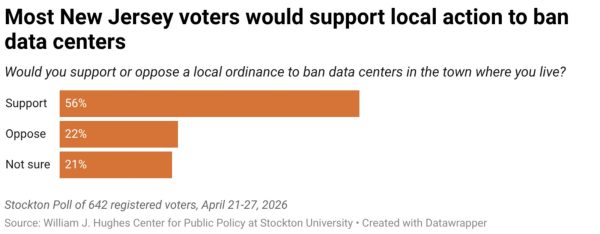
A Stockton poll released on May 5 showed 56% of New Jersey registered voters would support a ban on data centers in their town, while only 8% said data centers benefit their communities. Four in five said they were somewhat or very concerned about data centers’ impact on electricity cost. Almost three-quarters said AI will take more jobs than it will create, and 41% said AI will make their lives worse.
An FDU Poll released on April 14 found nearly two-thirds of voters supported a data center construction ban in New Jersey until more power plants could be built.
Sherrill, a Democrat and newcomer to state government, has prioritized energy since taking office in January. On data centers in particular, she announced a regulatory plan, with guidelines for community benefit agreements on noise, light and pollution plus investments in the needs of towns where they are located. She also signed legislation to set a separate power rate for New Jersey data centers, whose pressure on the grid was at least partly responsible for an average 20% electricity bill increase last year.
Town by town
In some places, local opposition to data centers is ongoing. The development of a 45-acre data center in Vineland, in the far south of the state, is drawing noise complaints. Union County residents are protesting construction on the former Merck campus in Kenilworth for a center that is expected to be operational next year.
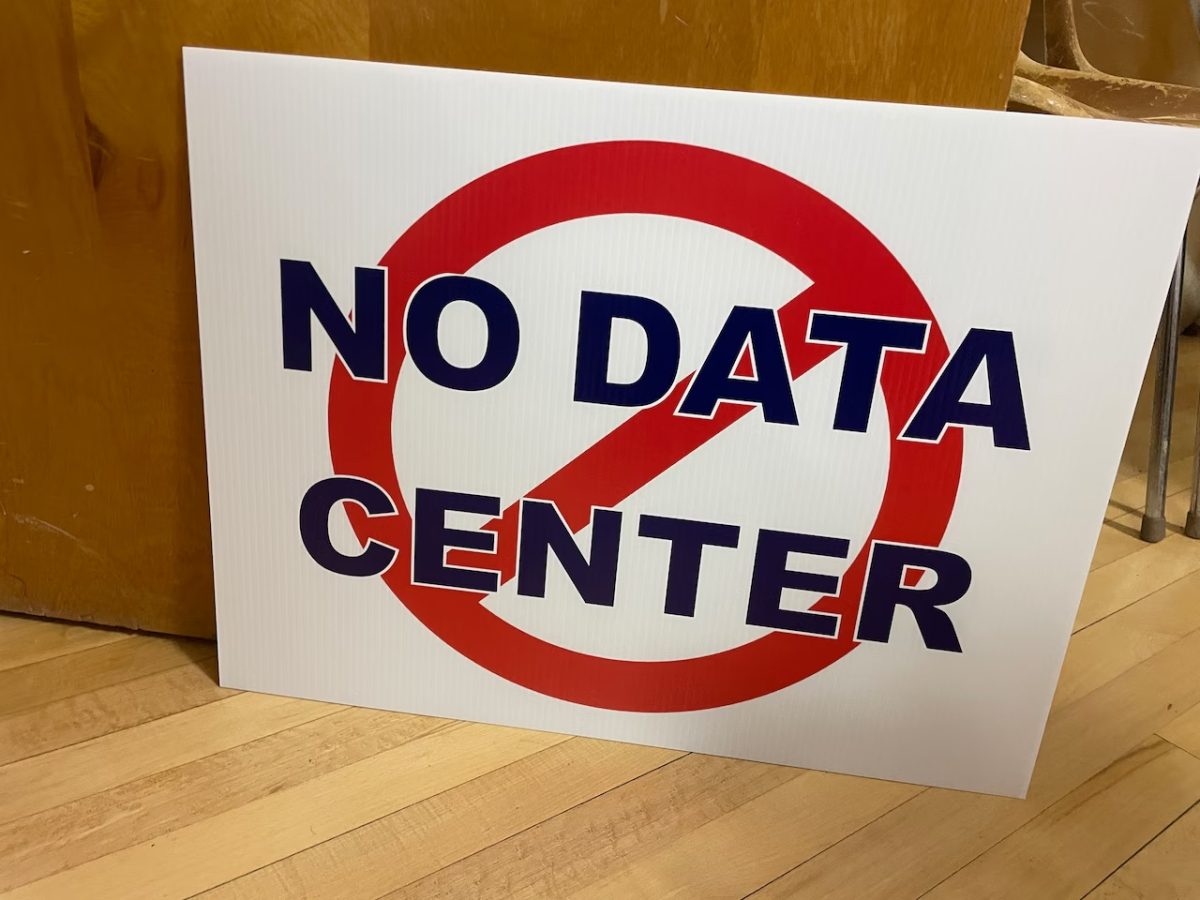
Other municipalities have said no. Pemberton Township in Burlington County banned data centers in mid-February, the first town in the state to do so, and about two dozen more towns have followed suit. Plainfield and Sayreville are considering such ordinances.
Neptune Township, along the Shore, on July 13 adopted an ordinance banning both data centers and immigrant detention facilities. In a statement, Deputy Mayor Derel Stroud said both “present serious concerns from resource consumption and environmental impact to due process and public safety.”
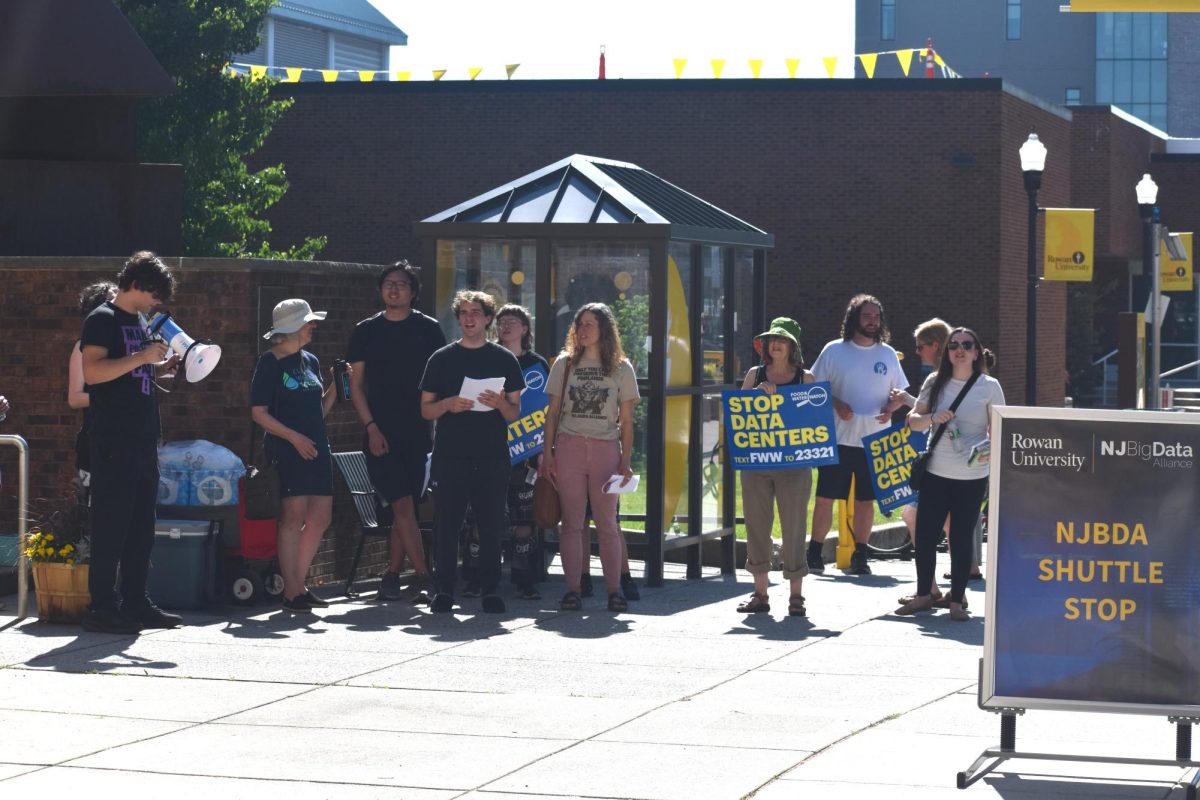
Throughout the state, activist groups are stepping in.
The nonprofit Pinelands Alliance has collected almost 9,200 petition signatures asking Sherrill to impost a three-year moratorium on the construction of new large-scale centers. The Climate Revolution Action Network, with a campaign called “Build Communities, Not Data Centers,” says it scored a victory in Neptune and another in New Brunswick, where a 27,000-square foot proposed center instead was designated as public space.
“Grassroots groups have been very effective in their outreach to residents, mobilizing turnout at public meetings, and keeping pressure on local officials,” Maurice said. “That kind of sustained community engagement can have a significant influence, especially when public opinion is already skeptical.”
At least one municipality, Andover, is facing legal action over its ban. On July 10, National Land Developers LLC of Media, Penn., which has an interest in developing a data center on Stickles Pond Road, sued the township, saying its decision was “arbitrary, capricious and unreasonable.” About 6,000 people live in Andover among protected forests, the state’s deepest glacial lake and a quaint downtown about 52 miles west of Manhattan.
“This lawsuit is a classic corporate intimidation tactic designed to bleed municipal resources and scare local officials into a quiet settlement,” said Birdie Green, co-founder of the Sussex Visibility Brigade, which helped to lead opposition. “We cannot, and must not, let this tactic work.”