
Customers heading to the Cluizel Chocolate Store in Berlin, New Jersey this Valentine’s Day may be in for some sticker shock.
Items in the Valentine’s Day collection range from $19 for a single bar with dried organic rose petals to $82 for a tin of dark truffles with chocolate-covered cocoa nibs, almonds, and cereal puffs.
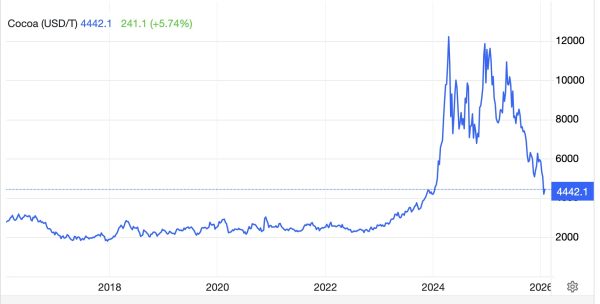
Chocolate costs more in recent years because the price of cocoa has risen sharply.
“We used to sell a bar [of chocolate] for less than $10,” said Jacques Dahan, president of the French-based, family-owned Michel Cluizel Paris, who oversees Cluizel’s U.S. store and Chocolatrium museum in Berlin Township. “Today, it’s almost $18.”
The main causes of the price increase are rising temperatures and shifting rainfall patterns that have damaged crops across cacao-growing regions, notably West Africa.

Climate Central reports that West African countries such as Cote d’Ivoire (the Ivory Coast) and Ghana, which both grow more than half of the world’s cocoa, have seen a considerable increase in days exceeding 90 degrees Fahrenheit, the optimal maximum temperature for cacao crop growth.
Rainfall has also changed from year-to-year as well, stressing the trees.
Dahan emphasized that the cacao growing process is complex and is dependent on many factors, including insects who pollinate the plants.
“When you have not enough flowers, you won’t have enough [cacao] pods,” said Dahan. “If you don’t have enough pods, you know the harvest will be bad.”
Additional factors include issues like trade tariffs, political unrest, and local farmers who are looking for more stable work.
All of this creates a volatile market for the price of ingredients, which makes it hard for local chocolatiers to keep prices affordable for customers.
Michael Collins, co-owner of Brooks Collins Chocolates in Tabernacle, said the costs of his ingredients have more than doubled in recent years.
“We used to buy gourmet chocolate at, for most of my career, anywhere between two or three dollars a pound,” said Collins, who has been a chocolatier for 33 years. “In the past year and a half, it’s jumped to between six and seven dollars a pound.”
Dahan and Collins, who pride themselves on quality, said they are also competing with other chocolate makers that have shifted to cheaper, artificial alternatives.
According to The New York Times, some candy companies like Hershey’s and Nestlé, have switched out cocoa butter for other fats to manufacture their products. As a result, the term milk chocolate, which is regulated by the Food and Drug Administration, has been replaced with the generic term “chocolate candy.”
Collins stated that food producers also invest money in other cacao-growing countries like Venezuela and South Africa to help ensure that there is a future for chocolate.
“These huge companies are definitely trying to support local farms…to keep chocolate and cocoa growing,” he said. “It’s scary sometimes thinking that prices could keep going up, but hopefully, they stabilize a little bit.”
Still, with everything that has been happening with the climate and the effects it has on the cost of chocolate, there remains some optimism for the future.
“I don’t think we’re going to be out of chocolate forever,” said Collins. “If we’re able to get these trees under control, the climate under control, then the price could come down a little bit.”
Dahan, who has been in the chocolate business for over 40 years, said chocolate makers have to be creative and be ready to adapt to price changes and what customers want. For Cluizel, that includes offering tours for customers so that they understand the process of how cocoa is grown, harvested, roasted and turned into chocolate.
“If you don’t have hope, you don’t wake up in the morning and go to work,” said Dahan. “It’s when you have to think, ‘Okay, this doesn’t work. How can I do it better, so it works? What can I offer that people will like?’”